The additional support is being funded by FEMA, and comes after Gov. Jared Polis issued a request for more assistance battling the virus. Currently, most hospitals across northern Colorado are operating their ICUs at, or beyond, capacity.
Amid a surge of COVID-19 cases in northern Colorado, the Department of Defense is deploying a team of medical workers to Fort Collins in an effort to better address the crisis. A team of roughly 20 nurses, providers and respiratory therapists will arrive at Poudre Valley Hospital next week and are assigned to help manage the spike in hospitalizations for the next month.
According to UCHealth they are currently serving more than 370 hospitalized patients battling COVID-19 in their health system, the highest rate of positive COVID-19 cases the hospital chain has seen in 2021. Approximately 100 of those infected patients are being cared for at UCHealth’s locations in northern Colorado, including Poudre Valley Hospital.
“Our providers and staff have been working long, hard days and nights for more than 20 months now. They are weary but continue to show up every day to serve our community with pride,” said Kevin Unger in a written statement to CBS4. “They will appreciate the support.”

Unger said his staff was grateful for the assistance, adding that they believe the assistance by the DOD will make a significant difference in their hospital.
The addition of the temporary staff will also help the UCHealth system further staff other hospitals in need by freeing up staff.
“We know the individuals on this medical response team will be spending the holidays away from their families, friends and homes to help us care for our community,” Unger said. “We thank them for their service and their sacrifice.”
Doctors Concerned About Trajectory Of COVID As Surge Continues, Hospitals At Or Beyond Capacity
For the first time since the Delta variant has caused a surge of COVID-19 cases and hospitalizations in northern Colorado, medical providers in the packed halls of the ICU are sharing their stories with CBS4.
Dr. Diana Breyer, chief pulmonologist and ICU doctor for UCHealth in northern Colorado, said her fellow medical providers are growingly concerned with the trajectory of the pandemic to end 2021.
“I am more worried now than I have been in the pandemic,” Breyer said. “This surge has been particularly hard.”
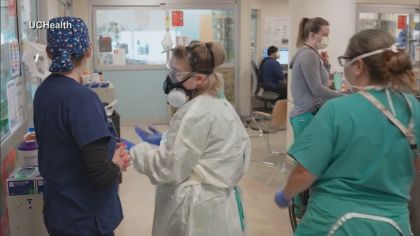
ICUs throughout Weld and Larimer counties have been operating at, or beyond, capacity for months. Rooms have been doubled with beds, filled with patients battling COVID-19.
At the same time staffing in UCHealth’s ICUs is stretched as many nurses have chosen to either retire or change professions as a result of the pandemic.
“The people who are left are tired,” Breyer said. “The fear is, if this continues and we become even more shorthanded, we could be giving care that is not adequate.”
Breyer said it’s emotionally and physically taxing to be an ICU medical worker during this phase of the pandemic.
“I wish people could see what I see in the ICUs,” Breyer said. “I’m heartbroken. Because, when I see patients, it is when they are really sick from COVID and often going on ventilators. When people get that sick with COVID there is a pretty high mortality rate.”
Breyer said roughly 25-30% of COVID patients who end up on a ventilator never wake up. And, according to Breyer, the state’s projections for the pandemic suggest that hospitalizations will increase to end the year.
Currently, 26% of UCHealth’s COVID-19 patients in the state are hospitalized in northern Colorado. A significant majority of those hospitalized are locals.
“We could reach a point where we don’t have enough beds,” Breyer said.
As first reported by CBS4’s Dillon Thomas, the Department of Defense and FEMA are teaming up to deploy medical workers to Fort Collins to help address the hospital capacity and staffing issues.
Breyer said many on staff feel, when they walk out of the hospital after a shift, they’re stepping into a world that has left them behind, also leaving them with a mess to pick up.
Making things worse, Breyer says most of the stresses of the job could’ve been avoided if people were getting vaccinated.
According to CDPHE those who are vaccinated are nearly four times less likely to contract COVID-19, nearly 10 times less likely to be hospitalized and nearly 14 times less likely to die from COVID.
“There are people dying currently who would not be dying if they had been vaccinated,” Breyer said. “We had so much hope a year ago when the vaccines came out that we were hoping we would never be here again.”