
A single home blood pressure reading is a weather report, not a climate record. It can shift after coffee, an argument, a rushed walk upstairs, a full bladder, or simply sitting with the cuff in the wrong place. A short, well-recorded series gives a clinician far more useful information. This blood pressure average calculator lets you add readings, calculate the average and copy a compact summary for an appointment.
It is a logging tool. It does not diagnose hypertension, choose a medication dose or tell you to stop a prescribed treatment. Keep the original readings and discuss a pattern with your care team. Everything entered below stays in this browser.
Home blood pressure average calculator
Add readings taken with the same monitor. Include the date, time of day, systolic and diastolic values in mm Hg.
How to take a home blood pressure reading
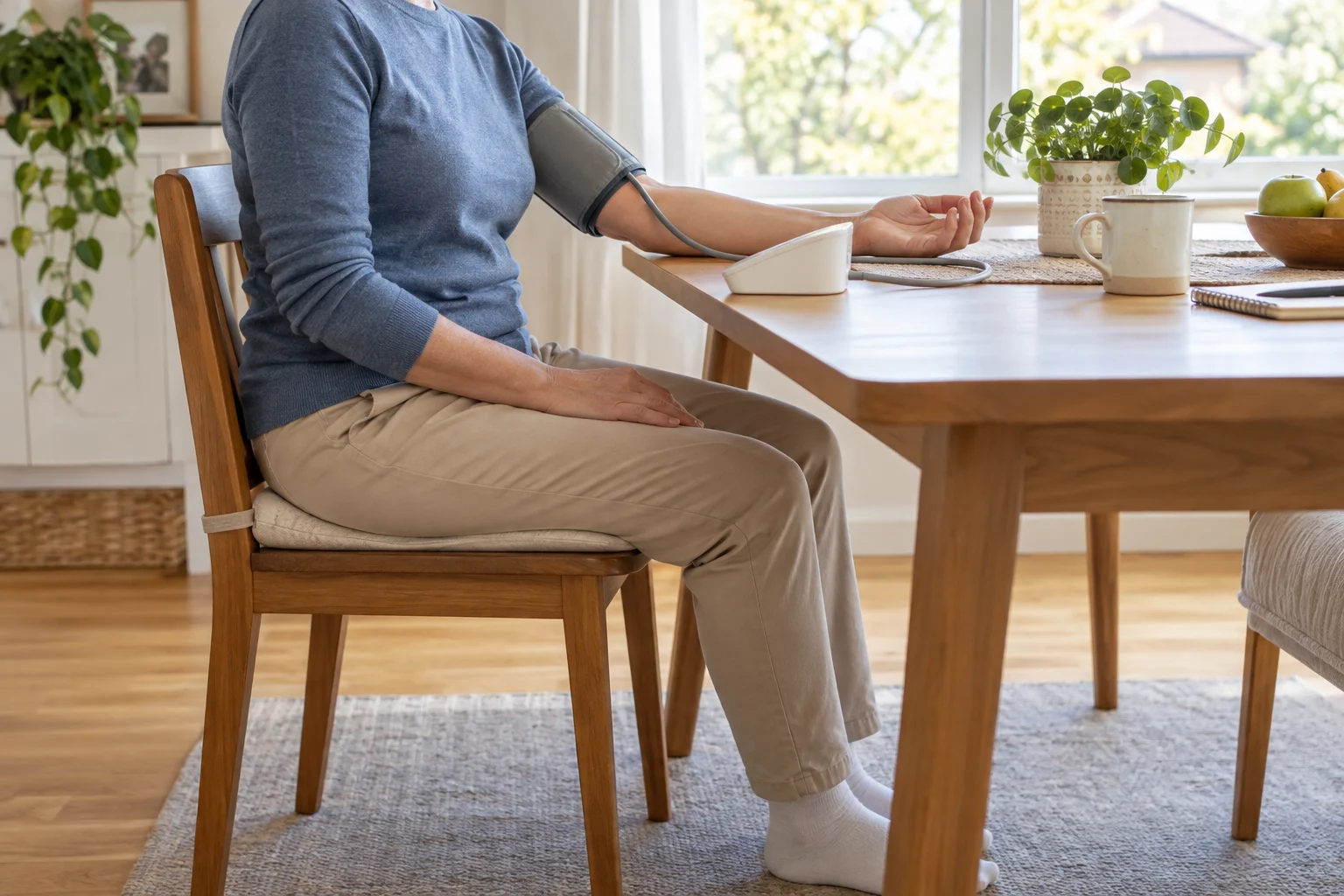
Technique changes the number. The American Heart Association and CDC both recommend an automatic upper-arm cuff monitor, a correctly sized cuff and quiet preparation. Avoid smoking, caffeine and exercise for 30 minutes before measuring. Empty your bladder. Then sit in a chair with your back supported, feet flat on the floor and legs uncrossed. Rest for at least five minutes. No talking, no phone scrolling, no balancing the cuff on a raised knee.
Place the cuff against bare skin, directly above the elbow crease as the device instructions show. Support the arm on a table so the cuff is at heart level. Take two readings one minute apart and record both. The AHA suggests measuring at the same times each day. Morning and evening sessions often make a practical routine, especially when a clinician has asked for a structured home series.
Use the same arm unless a clinician gives you a different instruction. Bring your monitor to an appointment from time to time so a clinician can compare it with an office reading and check cuff fit. A comfortable cuff that is the wrong size can still provide an inaccurate number.
The 7-day home-monitoring method
NICE describes a common home blood pressure monitoring approach for confirming hypertension when ambulatory monitoring is unsuitable: take two consecutive seated readings at least one minute apart, record twice daily, ideally morning and evening, for at least four days and ideally seven. The guidance says to discard the readings from the first day and average the rest. This calculator offers that exclusion as an option because its date fields make the earliest day visible.
A clinician may ask you to use another schedule. People changing treatment, people with pregnancy-related blood pressure concerns, people with symptoms, and people with complex conditions may need specific instructions. Follow the plan you were given rather than bending a general online protocol around a particular situation.

What a home blood pressure average can show
An average reduces the noise from one unusual reading. It does not erase important highs or lows, and it should never hide symptoms. Keep the individual values along with the calculated mean. A clinician may want to see the time of day, whether readings were before or after medicines, recent illness, pain, sleep disruption, alcohol, pregnancy or a new medication.
In the NICE diagnostic pathway, a home average of 135/85 mm Hg or higher alongside a clinic blood pressure of 140/90 mm Hg or higher helps confirm hypertension. That threshold belongs to a clinical diagnostic process. It should not be used to self-diagnose from a partial log, nor should a lower average be used to ignore concerning symptoms or stop medication.
Keep both numbers together. Blood pressure is written as systolic over diastolic, such as 120/80 mm Hg. The top and bottom numbers are averaged separately. Averaging the pair as one number would be meaningless arithmetic, even though a calculator could do it very confidently.
When a blood pressure reading needs urgent help
A single higher-than-usual reading is often a reason to pause, sit quietly and measure again. The AHA advises that when a reading is higher than 180/120 mm Hg, wait at least one minute and test again. If it remains that high, contact a healthcare professional immediately. Do not change prescribed medicine on your own while waiting for a number to settle.
Call emergency services if a reading above 180/120 mm Hg occurs with chest pain, shortness of breath, back pain, numbness, weakness, a change in vision or trouble speaking. Seek emergency care for severe symptoms even when you have not measured a number. A seven-day average has no role in an emergency.
Choosing and checking a monitor
Start with an automatic upper-arm monitor. The AHA recommends this style for home use. Look for clinical validation and a cuff size that matches your upper-arm circumference. In the United States, the independent ValidateBP device list can help identify monitors that meet published validation criteria. Availability and approved models differ by country, so a clinician or pharmacist can help with local options.
Wrist monitors can be harder to position accurately. They may be appropriate for some people when an upper-arm cuff is unsuitable, but that decision and technique deserve clinical guidance. Whatever device you use, follow its instructions, use fresh batteries or power as required, and do not assume that an old monitor remains accurate forever.
Frequently asked questions
How many readings do I need to calculate an average?
The calculator can average any complete readings you enter. For a structured diagnostic home-monitoring plan, NICE describes twice-daily readings for at least four days and ideally seven, with two readings in each session.
Should I exclude the first day?
NICE says to discard first-day measurements when using its home-monitoring approach to confirm hypertension. Use that option only when it matches the plan from your clinician. Keep the original readings in your record.
Can I average readings from different monitors?
It is better to use the same validated monitor and cuff during a home series. Switching devices can make a trend harder to interpret.
Can this tool tell me whether I have high blood pressure?
No. It calculates an average. Diagnosis depends on a valid measurement method, the full record and clinical interpretation.
Sources reviewed
- American Heart Association: Home blood pressure monitoring
- CDC: Measuring your blood pressure
- NICE NG136: Hypertension in adults, home monitoring
- ValidateBP: Validated blood pressure devices


